Giveaway: Following the Ghost of Modigliani’s Muse
Following the Ghost of Modigliani’s Muse
We featured it here on France Book Tours, and Linda was also part of our webinar on French artists in fiction.
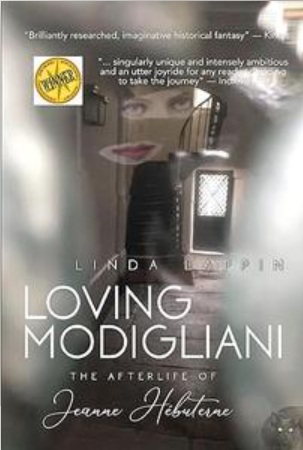
Today, Linda offers us “a brief look at the research and writing process behind her prize-winning novel Loving Modigliani: the Afterlife of Jeanne Hebuterne. a love story, a ghost story, a hunt for a missing masterpiece.”
“Imaginative, brilliantly researched, cross-genre historical fiction.”–Kirkus.
Click on this picture to access Linda’s flaneur guide to the places in her novel, with fascinating pictures and comments:

And now, more details on her book:
Loving Modigliani:
The Afterlife of Jeanne Hébuterne,
by
Linda Lappin
Historical mystery
Published December 15, 2020
at Serving House Books
Available in many places
(ebook and paperback)
344 pages
Amedeo Modigliani, embittered and unrecognized genius, dies of meningitis on a cold January day in Montparnasse in 1920.
Jeanne Hébuterne, his young wife and muse, follows 48 hours later, falling backwards through a window. Now a ghost, Jeanne drifts about the studio she shared with Modigliani—for she was not only his favorite model, but also an artist whose works were later shut away from public view after her demise.
Enraged, she watches as her belongings are removed from the studio and her identity as an artist seemingly effaced for posterity, carried off in a suitcase by her brother. She then sets off to rejoin Modigliani in the underworld.
Thus begins Loving Modigliani, retelling the story of Jeanne Hébuterne’s fate as a woman and an artist through three timelines and three precious objects stolen from the studio: a notebook, a bangle, and a self-portrait of Jeanne depicted together with Modi and their daughter.
Decades later, an art history student will discover Jeanne’s diary and rescue her artwork from oblivion, after a search leading from Paris to Nice, Rome, and Venice, where Jeanne’s own quest will find its joyful reward.
Check the book trailer!

ABOUT THE AUTHOR
 Prize-winning novelist, poet, translator, and lifelong wanderer
Linda Lappin writes stories rooted in place and memory.
Originally from Tennessee, she has spent much of her life in Rome,
and the landscapes of Italy, France, and Greece have deeply shaped her work.
Her fiction explores women on the edge of transformation,
weaving together history, myth, mystery, and the uncanny
in novels such as The Etruscan, Signatures in Stone, and Loving Modigliani.
Her novel Katherine’s Wish offers an intimate portrait of writer Katherine Mansfield
during the last five years of her life.
Loving Modigliani won the Women’s Fiction category
in the Indie Reader Awards in 2021,
was shortlisted for the Daphne du Maurier Awards,
selected for the Montaigne Medal for distinguished books,
and was the 2024 winner in Historical Fiction for the Indie Author Project.
Her newest novel, Melusine & the Watery Mind, is forthcoming from Serving House Books.
Check her website and subscribe to hear about her upcoming books.
You can also follow her on Instagram.
1 kinlde copy (US residents only)
 July 15, 2026
 WordsAndPeace