Posts tagged ‘Linda Lappin’

Katherine’s Wish: Excerpts and giveaway

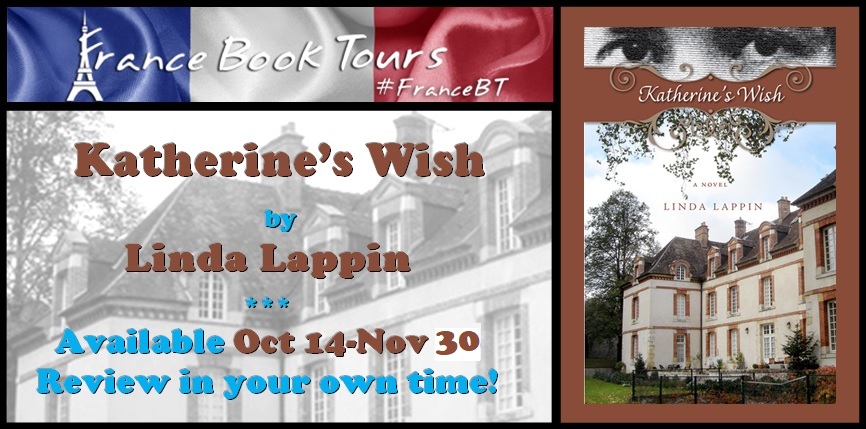
Katherine's Wish banner

After Loving Modigliani,

Linda Lappin

is back on Tour

October 14-November 14

with
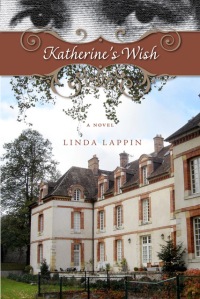
Katherine's Wish


Katherine’s Wish

(Historical fiction/fictional biography)

Officially released in 2008,
now re released in 2021
250 pages
Wordcraft of Oregon

Goodreads

📚📚📚

Buy it here:
Our bookshop

Also available from the publisher / on Amazon


SYNOPSIS

In this dramatic, fictional retelling of New Zealand writer Katherine Mansfield‘s final years, and of the events which led up to her meeting with P.D. Ouspensky and G. I Gurdjieff, novelist Linda Lappin transports the reader like a time traveler into Mansfield’s intimate world.
Scrupulously researched and richly evocative, the novel has been praised by Mansfield scholars as “creative scholarship.”
With vivid detail and beautiful language and style, Lappin has built on journals, letters, and diaries to fashion a true-to-life mosaic, using themes, motifs, and methods of Mansfield’s own writing.
Katherine’s Wish celebrates Mansfield’s deep love of life and its final message is a life-affirming one of joy and of wholeness achieved.

Finalist, ForeWord Book of the Year Award in fiction,
IPPY Gold medal in historical fiction,
honorable mention Hoffer Awards, honorable mention Paris Book Festival,
finalist Next Generation Indie Awards.

A radio play adaptation of Katherine’s Wish is forthcoming.

Eiffel Tower Orange

READ AN EXCERPT

PARIS, October 1922
Paris was soon behind them. Katherine sat very still and withdrawn, her eyes fixed on the window as the train rattled past the shabby little houses of the banlieu with their gray cabbage plots brightened here and there by yellow bursts of chrysanthemums, then on across charred fields where peasants were burning off the wheat stubble. In the
173
distance up ahead lay the forest of Fontainebleau, a dark streak on the horizon.
On the seat beside her lay a pair of dove gray gloves and a wilted bouquet of cyclamen Ida had insisted on buying for her from a beggar girl at the Gare du Lyon. At her feet, her leather valise containing only the essentials for an overnight trip. Her hat box and steamer trunk had been left behind at the Select Hotel for she had been invited to spend only one night in Fontainebleau at G. I.Gurdjieff’s Institute for the Harmonious Development of Man. If Mr. Gurdjieff accepted her as a pupil and allowed her to stay, she would send Ida back to Paris early in the morning to fetch her trunk and other belongings. The question was: would he say yes, and would he let her stay for as long as three months? That ought to be enough, she thought, though enough for what exactly, she was not sure.
Ida sat across from her, looking distraught, puzzling over a handful of coins, counting and recounting francs and sous. This journey, like so many others, would have been impossible without her assistance, and Katherine knew she should be grateful, yet Ida’s every awkward gesture, every little blunder jarred her nerves. She watched Ida fumbling in her pockets, pulling out more change. The train jolted. A five franc piece tumbled from her hand, rolled across the floor, and slipped, before their eyes, into a niche beneath a seat where it was now quite irretrievable.
“O Katie! Look what I’ve done! That was just what we needed for our cab fare.”
Katherine shrugged and said nothing. Her dependence on Ida was one of those chains from which, she hoped, she would soon be freed.
A ray of sun flashed on the gleaming brass name plate of her valise. Katherine stared at the engraved letters KMM, for Katherine Mansfield Murry. That was not the name printed on the passport she carried in the vest pocket of her overcoat, which was her real name, Kathleen Beauchamp Murry. But those were only two of a multitude: Kathleen, Katherine, Kath. Katie. Katya, Yekaterina, Kass, Kissienka, K.M., Tig She had a host of names ready for any occasion and each one conjured up a different woman. Lately she had begun to wonder, which, if any, of these characters was the real I? Your name is legion, Ouspensky had said. Who was she really? Only a nameless pair of eyes, she often thought, absorbing the world into a pitiless gaze. To this thought she had returned often over the last few weeks: I have been a camera, a mere mechanical observer. At times it seemed to her she could even detach herself from her own body, as it jerked and coughed like a mechanical doll, while another eye looked down upon her from above, gilding all with a light from elsewhere. Was that perhaps the inner light of Self Gurdjieff promised to awaken?
Now the train skirted a dense wood. It was a golden autumn afternoon. The woods were full of people out walking on pathways thickly carpeted with dead leaves. A fellow roaming with two ginger-colored hunting dogs waved at the train as it passed.
When does a journey really begin, thought Katherine, as the man with the dogs met her eyes, then slid away in the window. It was a little like falling in love or running into debt. The beginning is so subtle you may not notice, then suddenly there you are hurtling into the distance on a train. And there’s no turning back until you reach the end of the line, until you have gone all the way through with it, burning your bridges if need be, and leaving everything tidy in case you never make it back.

LISTEN TO AN EXCERPT

Eiffel Tower Orange

ABOUT THE AUTHOR

Katherine's Wish_Linda Lappin

Linda Lappin has published four novels:
The Etruscan (Wynkin de Worde, 2004);
Katherine’s Wish, dealing with the life of Katherine Mansfield (Wordcraft, 2008),
shortlisted for Foreward Book of the Year
and IPPY gold medal winner in historical fiction;
Signatures in Stone: A Bomarzo Mystery, winner of the Daphne DuMaurier Award
from RWA for the best mystery novel of 2013;
and Loving Modigliani: The Afterlife of Jeanne Hébuterne.
She is also the author of The Soul of Place: Ideas and Exercises for Conjuring the Genius Loci,
winner in 2015 of the gold medal in creativity in the Nautilus Book Awards.
She lives in Rome.

Visit the author’s website and her blog.
Follow the author on Facebook, and Twitter
Join her mailing list


COME BACK ON OCTOBER 20
for enthusiastic reviews!


Eiffel Tower Orange


CLICK ON THIS BANNER TO REQUEST THE BOOK
AND/OR TO ENTER OUR GIVEAWAY

Katherine's Wish banner


Linda Lappin on tour: Katherine’s Wish

After Loving Modigliani,

Linda Lappin

is back on Tour

October 14-November 30

with

Katherine's Wish


Katherine’s Wish

(Historical fiction/fictional biography)

Officially released in 2008,
now re released in 2021
250 pages
Wordcraft of Oregon

Goodreads

📚📚📚

Buy it here:
Our bookshop

Also available from the publisher / on Amazon


SYNOPSIS

In this dramatic, fictional retelling of New Zealand writer Katherine Mansfield‘s final years, and of the events which led up to her meeting with P.D. Ouspensky and G. I Gurdjieff, novelist Linda Lappin transports the reader like a time traveler into Mansfield’s intimate world.
Scrupulously researched and richly evocative, the novel has been praised by Mansfield scholars as “creative scholarship.”
With vivid detail and beautiful language and style, Lappin has built on journals, letters, and diaries to fashion a true-to-life mosaic, using themes, motifs, and methods of Mansfield’s own writing.
Katherine’s Wish celebrates Mansfield’s deep love of life and its final message is a life-affirming one of joy and of wholeness achieved.

Finalist, ForeWord Book of the Year Award in fiction,
IPPY Gold medal in historical fiction,
honorable mention Hoffer Awards, honorable mention Paris Book Festival,
finalist Next Generation Indie Awards.

A radio play adaptation of Katherine’s Wish is forthcoming.

France Book Tours is honored to start featuring this book on October 14,
which happens to be Katherine Mansfield’s birthday!

Eiffel Tower Orange

 ENTER THE GIVEAWAY HERE

Giveaway open to all
4 winners will receive a ecopy of this book
1 US resident will receive a print copy

 Eiffel Tower Orange 

AND/OR FILL IN THE FORM BELOW
TO REQUEST YOUR COPY

If you would love to read
this historical novel
request it before November 30,
and review it in your own time!
Your review will be featured on France Book Tours!
You can also just feature a spotlight on your own blog.
Please fill in this quick form here below


Eiffel Tower Orange

ABOUT THE AUTHOR

Katherine's Wish_Linda Lappin

Linda Lappin has published four novels:
The Etruscan (Wynkin de Worde, 2004);
Katherine’s Wish, dealing with the life of Katherine Mansfield (Wordcraft, 2008),
shortlisted for Foreward Book of the Year
and IPPY gold medal winner in historical fiction;
Signatures in Stone: A Bomarzo Mystery, winner of the Daphne DuMaurier Award
from RWA for the best mystery novel of 2013;
and Loving Modigliani: The Afterlife of Jeanne Hébuterne.
She is also the author of The Soul of Place: Ideas and Exercises for Conjuring the Genius Loci,
winner in 2015 of the gold medal in creativity in the Nautilus Book Awards.
She lives in Rome.

Visit the author’s website and her blog.
Follow the author on Facebook, and Twitter
Join her mailing list


READ AN EXCERPT (print and audio)
Discover enthusiastic reviews!


Eiffel Tower Orange


 ENTER THE GIVEAWAY

Giveaway open to all
4 winners will receive a ecopy of this book
1 US resident will receive a print copy

Incentive program:

Sign up for this book tour,
publish your review/spotlight in your own time!
If you cross-post your review on various platforms,
and share the links on this form,
you will earn credits towards
a $10 gift card of your choice.


Post webinar questions and answers

“French artists in fiction: four lives, four authors”

Post webinar questions and answers


At the beginning of May, France Book Tours organized a webinar entitled “French artists in fiction: four lives, four authors”. You can watch it by clicking on the link

Since then, two of these authors have won Indie Reader Discovery Awards.

Our listeners asked several excellent questions during the webinar. We didn’t have time to answer to all of them, so we asked our four authors to send us their answers:


What was the biggest challenge in writing a book that includes real historical figures and places and fictional characters and places?


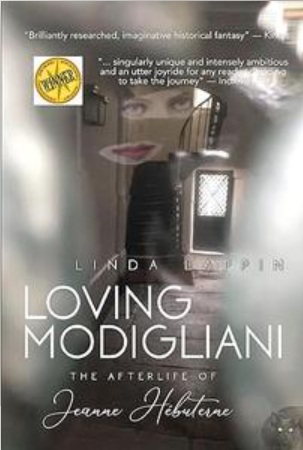
Loving Modigliani_Linda LappinLinda Lappin

In any set of historical events, there are facts that can be researched and pieced together – although sometimes fragments of information may be in conflict with each other. Memory – collective or individual —  is fallible, and historical records come down to us selected, filtered, picked over and interpreted by previous generations.   There are also gaps and shadows in the lives of historical figures and in records of events themselves.
It’s up to the novelists and film makers to fill in the gaps and provide the missing links. When writing  a historical novel, you try to get your facts right,  and  build a solid and believable background, but you need to feel free to enter in the spirit of the characters, to breathe life into them. By leaps of imagination, you identify with people of another era and immerse yourself in the Zeitgeist.  I think this is the most challenging thing.

Victorine_Drema DrudgeDrema Drudge

The biggest challenge in writing a novel that includes real historical figures and places and fictional characters and places was trying to keep it plausible. These figures, both real and imaginary, had to fit into the time and place represented and couldn’t express totally modern sensibilities, and yet sometimes I gave them a bit of a modern viewpoint because I needed to make my point. I tried to make the imaginary characters mesh with the real ones in ways I thought they might have met and interacted.
For instance, Willie was not a real character, and yet he seemed entirely believable to me. Victorine would have been drawn to someone like him, would have had mixed feelings for him the same way she did with practically everyone else. And he was the sort of person who was good for her because he had no expectations.

Monet and Oscar_Joe Byrd

Joe Byrd

Accuracy. If you don’t get all of the facts correct down to the smallest detail, someone is sure to call you on it. This will add to confusion to the reader and loss of reputation of the author. Keeping the timing straight was my biggest challenge. Since I didn’t start with a time line for events, I had to go back an rewrite sections to get the timing and elapsed time correct. I won’t make this mistake again.

How did you balance becoming a writer with your regular daily life?

L'Origine - Lilianne Milgrom

Lilianne Milgrom

Balance is always hard. It’s a juggling act. Something had to give, and that turned out to be my art practice. All my creative energies were directed towards writing the novel. I work well very late at night because I crave absolute silence and hate distraction when I’m writing. Thank you for asking!


Linda Lappin

I retired only a year ago, a few weeks before the pandemic. I worked full time  for 39 years as a language teacher in Italian universities, and for 22 of those years, I was a commuter on very slow trains. I had to take advantage of every minute for my writing. Fortunately my schedule varied over the semesters, there were teaching weeks and exam weeks, leaving blocks of free time. it was possible to organize my life to have writing and editing time in my off hours and on my free days. But it’s a challenge.

Drema Drudge

Balancing being a writer with my everyday life is sometimes easy, sometimes difficult. My husband was my patron saint for a time and told me to leave my day jobs (I was teaching and freelance writing) and finish writing Victorine! So I did. It was both a joy to write every day and guilt inducing. I worried that I was being allowed to live my dream at my husband’s expense. He was totally for having me write, and I will never forget his generosity or how he supported me in every way.

I’m back to teaching a bit and now I’m working in book marketing. I’m having to relearn how to balance my writing and working life. It’s not easy. When I’m doing one thing, I’m thinking I should be doing something else. But I’m beginning to practice a method called Monday Hour One where you write down all that you want and need to do for the week and then you schedule in your free time first and after that everything else. I think this could work, once I get used to it. But in my case, I may end up scheduling in my writing time first and then my free time. Because often what I’d choose to do with my free time is write!

Joe Byrd

That was easier because I wrote during the pandemic lockdown. I wrote in any bit of time I could find between caring for an ill wife and daily chores.

How do you stop researching and begin writing?

Lilianne Milgrom

It’s a great question because so many historical novelists don’t want the research to stop because we keep digging up the most amazing little snippets that we want to incorporate into the story. It’s a particularly sweet feeling to slip a little snippet in knowing the readers may or may not realize it’s based on fact! In my case, I was a history major and love to delve into the past. But at some point there is just information overload and you want to start telling the story. It took me years to come to that point!

Linda Lappin

It’s like the cocoon of a butterfly. You have spun it around you and puffed it out, and inside unbeknownst to anyone, a transformation is taking place, things are knitting together. And the moment just comes when what’s inside has to break out and fly away. It’s instinctive really.  It just happens.

Drema Drudge

I have a historical writer friend who says once she has researched enough she knows it and she begins writing right away. It’s a struggle for me, knowing when to stop researching.
In my case, what we know about Victorine is limited, so there was only so much direct research I could do. But of course I studied all the way around her, history, art, culture, war, and I had to eventually start writing and then only research when I found a gap.
You can always do more research. At some point, you have to say that you know the story you are going to tell, and you plunge in.

Joe Byrd

You don’t. You finish the biggest part of your research when you think you know enough about the character and situation to make sense of the story. But you never really finish researching. Researching during the writing process is much more focused on individual details that are important to the story. You must delve into details and make sure you are making sense of them. If not, someone will call you on them. The devil is in the details is a constant mantra. 

What do you think of Orlan’s take on L’Origine, called L’Origine de la Guerre, exhibited at the Musée d’Orsay? 

Lilianne Milgrom

I LOVE Orlan’s take on L’Origine. She is spot on and I think her painting is conceptually brilliant. The titles of the two paintings reflect the gender differences in a nutshell!! Thank you for asking!

Linda Lappin

A thought-provoking take on patriarchal power and its ultimate goals.

LET’S KNOW YOUR THOUGTHS ABOUT OUR AUTHORS’ ANSWERS